## Introduction
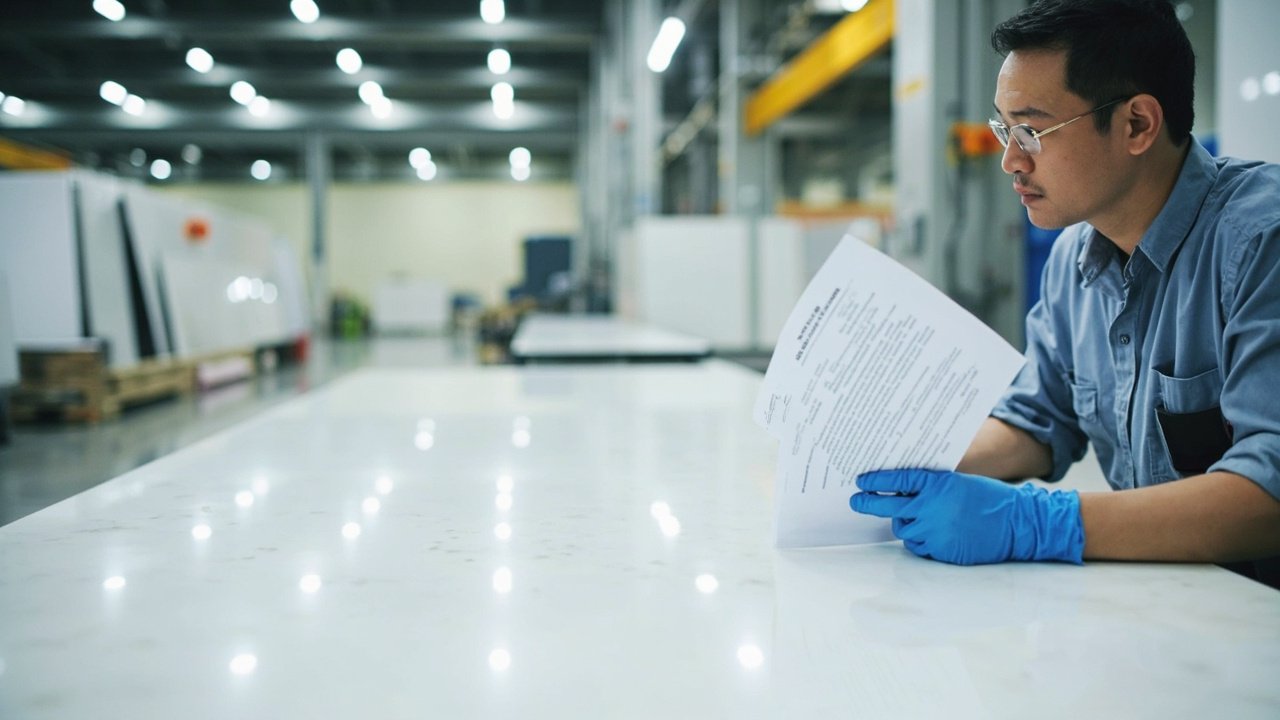
You just received a quality report from your Chinese quartz factory. You stare at the PDF — packed with technical specifications, test methods, numbers, and terminology — and you realize you have no idea what you’re looking at.
What does “Static Coefficient of Friction ≥ 0.60” actually mean for your kitchen countertop project? Is a “Water Absorption Rate of 0.035%” good enough for a hotel bathroom in Dubai? Why does the report mention both “QB/T 5166-2017” and “GB/T 35165-2017” standards, and which one matters more for UAE projects?
If you’ve ever felt lost reading a quartz slab quality report, you’re not alone. Most buyers in the UAE stone trade have learned to trust factories by proxy — relying on reputation and sample quality rather than actually understanding what the test numbers mean.
This guide changes that. After reading this, you’ll be able to read any quartz slab quality report with confidence, spot red flags before they become expensive problems, and use the data to negotiate better prices with your suppliers.
## Breaking Down Each Key Test Parameter
### 1. Flexural Strength (抗折强度)
**What it is**: The slab’s resistance to bending stress. This is the most critical property for countertop applications, especially for installations with overhangs like kitchen islands and bar counters.
**How it’s measured**: A rectangular specimen is supported at two points and force is applied at the center until it breaks. The result is expressed in MPa (megapascals).
**What the numbers mean**:
| Performance Level | MPa Value | Application Guidance |
|——————|———–|———————-|
| Below Standard | < 30 MPa | Avoid for structural applications |
| Standard Residential | 30–40 MPa | Acceptable for basic kitchen counters |
| Commercial Grade | 40–50 MPa | Recommended for commercial kitchens, large overhangs |
| Premium Grade | > 50 MPa | Heavy-use counters, large islands with 25cm+ overhangs |
**For UAE buyers**: Look for ≥ 40 MPa as a baseline. If you’re installing a large kitchen island with a 30cm or greater overhang, insist on ≥ 50 MPa and verify this with the factory before production.
### 2. Compression Strength (抗压强度)
**What it is**: Resistance to crushing force applied uniformly across the surface. Less critical for vertical countertop applications but matters for flooring.
**Typical values**: 150–200 MPa is standard for quartz slabs from quality factories. This exceeds most building code requirements by a significant margin.
You rarely need to negotiate on this parameter — it’s consistently strong in any quality facility. However, if you see compression strength below 120 MPa, that’s a red flag.
### 3. Water Absorption Rate (吸水率)
**What it is**: The percentage of water absorbed by the slab when immersed. Lower is better — it means the slab is denser and less porous.
**Why it matters in the UAE**: High humidity and coastal conditions in Dubai, Abu Dhabi, and Jeddah mean that porous stone can absorb moisture over time, leading to staining, warping, efflorescence, or mold growth. For kitchen and bathroom applications — where the slab is regularly exposed to water — this is non-negotiable.
**What to look for**:
| Water Absorption | Rating | Recommendation |
|——————-|——–|—————-|
| ≤ 0.03% | Excellent | Preferred for all UAE applications |
| 0.03% – 0.05% | Very Good | Acceptable for kitchen/bathroom |
| 0.05% – 0.10% | Acceptable | Use for interior walls only, not wet areas |
| > 0.10% | Problematic | Avoid for any wet-area application |
**For UAE kitchen and bathroom applications**: Insist on ≤ 0.05%. For a luxury hotel bathroom where the slab will be exposed to steam and repeated water contact, push for ≤ 0.03%.
### 4. Abrasion Resistance (耐磨度)
**What it is**: The slab’s resistance to surface wear from foot traffic, cleaning, and daily use.
**How it’s measured**: The Taber Abrasion Test uses a rotating disc with an abrasive wheel. The result is reported as “cycles” — the number of rotations required to wear through the surface finish to the point where a defined depth of wear is reached. Lower numbers mean better abrasion resistance.
| Taber Abrasion Value | Performance | Application |
|———————|————-|————-|
| ≤ 60 cycles | Excellent | High-traffic commercial floors and counters |
| 60–90 cycles | Good | Standard residential and commercial use |
| 90–130 cycles | Acceptable | Low-traffic interior applications |
| > 130 cycles | Poor | Not recommended for floors |
**For kitchen countertops**: Look for Taber ≤ 80 as a minimum. If the factory can’t provide this number, ask for it specifically — a quality factory will have this data.
### 5. Stain Resistance (耐污染性)
**What it is**: How resistant the slab surface is to permanent staining from common household and commercial agents.
**How it’s tested**: Standard test liquids — coffee, olive oil, red wine, ink, and common cleaning chemicals — are placed on the slab surface for 24 hours under controlled temperature conditions. After exposure, the surface is cleaned with specified agents and the stain remaining is rated on a scale of 1–5 or as “pass/fail” for each agent.
**What to look for**: Check which staining agents were tested. For kitchen use, you need coffee and cooking oil resistance as minimum. For bathroom applications, add cosmetics and toothpaste to the test list.
**Important**: Stain resistance tests measure the slab’s response to specific chemicals. If the factory’s test only covers water-based agents but your kitchen will encounter oil-based substances (cooking oils, greasy foods), the test is incomplete. Request a test that includes the specific substances relevant to your application.
### 6. Static Coefficient of Friction (摩擦系数)
**What it is**: A measure of how slip-resistant the surface is. Critical for flooring applications, less critical for countertops.
**Standard requirement**: ≥ 0.60 for dry interior floor surfaces under most building codes.
| COF Value | Slip Resistance |
|———–|—————–|
| < 0.50 | Dangerous when wet — avoid for flooring |
| 0.50–0.60 | Moderate — acceptable for residential dry areas |
| ≥ 0.60 | Safe — standard for interior flooring |
| ≥ 0.70 | High traction — recommended for bathrooms and commercial wet areas |
**For UAE bathroom and commercial flooring**: Look for ≥ 0.70. Some factories offer specific textured or matte finishes explicitly to increase this value — useful for projects where slip resistance is a specification requirement.
### 7. Surface Hardness (表面硬度)
**Reported as**: Mohs scale value. Quartz scores 6.5–7 on the Mohs scale (for reference: glass scores 5.5, diamond scores 10, talc scores 1).
This parameter is consistent across virtually all quartz slabs — quartz is quartz. The Mohs hardness is primarily relevant for selecting cutting tools and understanding scratch resistance. You don't need to spend significant time analyzing this parameter in a quality report.
## Common Red Flags in Quality Reports
### Red Flag 1: Missing Water Absorption Data
If the report doesn't include water absorption rate, ask for it specifically. A quality factory will always test this parameter — it's the most basic indicator of slab quality. If they can't provide it, that's a quality concern. Walk away or negotiate a significant discount to compensate for the unknown risk.
### Red Flag 2: Generic "Passed" Without Actual Numbers
Some reports say "Passed" or "Conforms" without showing the actual measured values. This is suspicious. A genuine test report should show the actual reading for each parameter — not just a pass/fail. Ask for the full data table.
### Red Flag 3: Test Date Older Than 3 Months
If the report is more than 3 months old and the factory claims it's still valid for your order, be cautious. Raw material formulations change, production conditions drift, and quality can shift over time. Ideally, request a fresh test for your specific production batch.
### Red Flag 4: Missing Tests for Your Application
If you're buying for kitchen countertops but the report has no stain resistance test — or only tests for water-based agents — that's a significant gap. It doesn't necessarily mean the slab is bad, but you should request the additional test before placing the order.
### Red Flag 5: Different Standards for Different Properties
Some factories test some properties to QB/T and others to internal methods. Ask which standard applies to each test item. For export to UAE, QB/T 5166-2017 is the standard baseline. If internal methods are used, ask how they compare to the standard method.
### Red Flag 6: Large Gap Between Report Values and Physical Samples
If the quality report shows excellent numbers but the samples you received feel lighter, have visible pores, or show inconsistent color, request samples from the actual batch cited in the report. Quality factories will provide batch-matched samples. A factory that can't or won't should raise serious concerns.

## FAQ: Understanding Quartz Slab Quality Reports
### Q1: Can I trust a factory’s own quality report, or should I hire a third-party inspector?
Factory reports are generally reliable for their own testing — factories have no incentive to falsify their own quality data (it would come back to bite them when the goods arrive and fail inspection). However, if you’re ordering a full container for the first time from a new supplier, consider hiring a third-party inspector (firms like AsiaQuality, QIMA, or Bureau Veritas operate in China) to verify the batch. Cost: $200–400 for a full inspection including pre-production and pre-shipment checks.
### Q2: What is the minimum set of tests a quartz slab quality report should include for UAE projects?
For UAE projects, the minimum test requirements are: flexural strength, compression strength, water absorption, surface abrasion (Taber), stain resistance, dimensional tolerances, and batch number/date. If any of these are missing, ask the factory to provide them.
### Q3: The report shows different values for the same property under different test conditions. Which one matters?
Check if the report lists multiple test methods (e.g., dry vs wet conditions, or different load directions). For water absorption, the wet condition results are the real-world benchmark. For flexural strength, the lower value under different conditions is what you should use for safety margin calculations.
### Q4: Our project requires EN 15285 compliance. How do I verify this from a Chinese factory?
Ask the factory for the test report conducted specifically to EN 15285 standard. Check the test method column — it should reference EN standards (e.g., “EN 15285:2008” or “EN 14617-1” for test methods). You can verify the test house’s accreditation on the Emirates Authority for Standardization (ESMA) website or through your customs agent.
### Q5: The factory report has better numbers than the samples I received. Is this normal?
This is a serious red flag. Request samples from the actual batch referenced in the report. Batch samples should match the test results. If they don’t, the factory may be cherry-picking the best slabs for testing while shipping regular production material. This is grounds to delay payment and renegotiate.
### Q6: How do I get a quality report for a custom color or finish that the factory hasn’t tested?
Custom colors require a new production run and a new test. Ask the factory to produce a test batch of your custom color before the full production run. This adds 2–4 weeks to your timeline and may cost $200–400 for the test, but it’s worth it to know the quality of the actual product you’ll receive.
*For your next stone order, download our Quartz Slab Specification Sheet for UAE Projects — a pre-filled template listing minimum test requirements and acceptable values for kitchen, bathroom, and flooring applications that you can send directly to factories.*